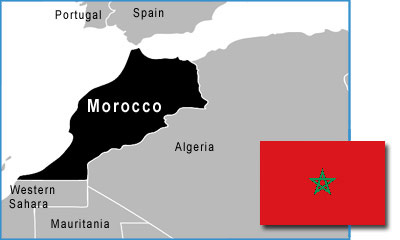
Independent in 1956 from French and Spanish rule, Morocco experienced limited democracy with an executive monarchy under King Hassan until his death in 1999. His successor, King Mohammed VI, instituted liberalizing changes, but shifted to a much more repressive stance in 2010. A growing Islamist presence opposes these changes, and terrorist bombings in 2003 showed the threat radical Islam poses to Morocco’s stability. Since then it has vied with a sophisticated materialistic Islam for prevalence in the political sphere.
Sunni Islam is the state religion; the existence of Christians and Jews is tolerated, but the government does not accept the existence of an indigenous Moroccan Church. The opposing influences of prosperous, hi-tech Middle Eastern Islam and hard-line radical Islam both exert considerable pressure. It is legal both to talk about Christ and to invite friends home for discussion, but authorities carefully monitor all known Christian activity.
In 2010, a large number of expatriate Christians were deported and institutions with a Christian ethos closed. Local Christians are harassed and intimidated by police informers; some Christians have been imprisoned, accused of proselytizing. The media stir up public prejudice against the gospel. Of Morocco’s 32.7 million people, Christians account for 29,000.
Prayer Requests
- Pray that many churches and mission agencies will take up the challenge of reaching out to the Muslims in Morocco with the love of Christ
- Pray those who are seeking Christ will come to faith in Him.
- Pray for peace throughout the nation, and pray that those seeking to commit violence be stymied. Pray for the country’s leaders; may they lead with wisdom and good decision-making.
Independent in 1956 from French and Spanish rule, Morocco experienced limited democracy with an executive monarchy under King Hassan until his death in 1999. His successor, King Mohammed VI, instituted liberalizing changes, but shifted to a much more repressive stance in 2010. A growing Islamist presence opposes these changes, and terrorist bombings in 2003 showed the threat radical Islam poses to Morocco’s stability. Since then it has vied with a sophisticated materialistic Islam for prevalence in the political sphere.
Sunni Islam is the state religion; the existence of Christians and Jews is tolerated, but the government does not accept the existence of an indigenous Moroccan Church. The opposing influences of prosperous, hi-tech Middle Eastern Islam and hard-line radical Islam both exert considerable pressure. It is legal both to talk about Christ and to invite friends home for discussion, but authorities carefully monitor all known Christian activity.
In 2010, a large number of expatriate Christians were deported and institutions with a Christian ethos closed. Local Christians are harassed and intimidated by police informers; some Christians have been imprisoned, accused of proselytizing. The media stir up public prejudice against the gospel. Of Morocco’s 32.7 million people, Christians account for 29,000.
Prayer Requests
· Pray that many churches and mission agencies will take up the challenge of reaching out to the Muslims in Morocco with the love of Christ
· Pray those who are seeking Christ will come to faith in Him.
· Pray for peace throughout the nation, and pray that those seeking to commit violence be stymied. Pray for the country’s leaders; may they lead with wisdom and good decision-making.
Statistics provided by CIA World Factbook and Operation World.
Location
Africa
Population
31,968,361 (July 2011 est.)
Ethnicity (%)
Arab-Berber (99.1), other (0.7), Jewish (0.2)
Religion (%)
Muslim (99.88), Christian (0.09), Jewish (0.02), Non-religious (0.01)
Leader
King Mohammed VI
(since July 30, 1999)
Government type
Constitutional monarchy
Legal system
Based on Islamic law and French and Spanish civil law systems