Persecution News - Eritrea
New wave of arrests sweeps across Eritrea
(December 24, 2008)
Imprisoned Christian dies, more believers arrested
(November 05, 2008)
Five More Evangelicals Arrested
(September 05, 2008)
Christian students imprisoned in shipping containers
(August 13, 2008)
Imprisoned Christian Woman Dies
(July 23, 2008)
More Christians Arrested
(June 04, 2008)
More Christians Arrested; Imprisoned Pastors may Face Treason Charges
(May 28, 2008)
Christians Released from Prison
(February 27, 2008)
Christians Arrested in Massawa
(January 30, 2008)
Eritrea Profile
|
Country Reports
| Eritrea |
|
|
|
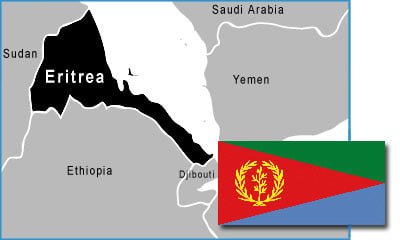
In 1952, Eritrea joined Ethiopia as part of a federation. When Ethiopia annexed Eritrea as a province 10 years later, a struggle for independence began that ended with victory by the Eritrean rebels in 1991. In 1998, a border war with Ethiopia began, ending with a peace agreement through intervention from the U.N. in December 2000, though Eritrea and Ethiopia have yet to agree as to exactly where the border lies between the two countries. Until 2002, there was generally freedom to practice religion. However, Eritrean authorities have recently begun a campaign of open persecution against evangelical Christians. It began as a government-led rejection of any non-Orthodox Christian communities. In May 2002, the government announced that all churches other than Orthodox, Roman Catholic and Lutheran (Orthodox Church of Eritrea, Sunni Islam, the Roman Catholic Church, and the Lutheran-affiliated Evangelical Church of Eritrea are approved according to CIA) were to be closed immediately. Since then, hundreds of evangelical Christians have been arrested for practicing what officials are calling "a new religion." At the same time, they adamantly deny that any persecution is taking place at all. The truth of the arrests has been verified by numerous reliable reports coming out of Eritrea. The flood of arrests has motivated the United States to designate Eritrea a “Country of Particular Concern,” a designation reserved for countries with the worst of human rights offenses. In fact, in his February 7, 2005 editorial on Asmarino.com, journalist Habtom Yohannes states that the Eritrean government has established a task force specifically to eradicate all "menfesawyan" ("spirituals" - a term often used to describe charismatic Christians) from the country by the end of 2005. By all appearances, they are well on their way to accomplishing their goal. Close to two thousand believers remain in Eritrean prisons where they face deplorable conditions. According to Release Eritrea, these numbers mean that approximately one in ten Eritrean evangelicals are presently being detained. Kelati Awalom, a member of the Rhema Church, was arrested for a third time on March 17, 2004 and was detained for three months, along with two of his daughters. According to reports, he was beaten until he was partially paralyzed. After his release, he continued to suffer the effects of the beating until he died at his home on July 24, 2005. This disregard for basic human rights is not unusual. In fact, where temperatures can soar above 40 degrees Celcius, many believers are held in metal shipping containers with no ventilation or toileting facilities. It would seem that authorities will use any excuse to incarcerate believers. Weddings in particular have been targeted lately. In January 2005, Pastor Oqbamichel Haimanot of the Kale Hiwot (Word of Life) was arrested at a wedding ceremony. After months of physical and emotional mistreatment, Pastor Haimanot suffered a mental breakdown. Despite being in very poor health, he has been denied any medical treatment. Even children are not exempted from persecution. On February 19, 2005, 131 children between the ages of two and eighteen were rounded up by police and taken to a police station for questioning. In the hall at the police station, the children began to sing, “I am not afraid of persecution, hardships and even death. Nobody can separate me from the Love of Jesus Christ. He died on the cross and he gave me new life.” Their resolve was tested when some were beaten and those over fifteen were transferred to another police station where they were detained. Despite this open persecution, the government continues to support its statement issued in May 2003 that "no groups or persons are persecuted in Eritrea for their beliefs or religion." Prayer Requests
|